

Product Sell Sheet vs Brochure: Which One Works Better for B2B Sales?
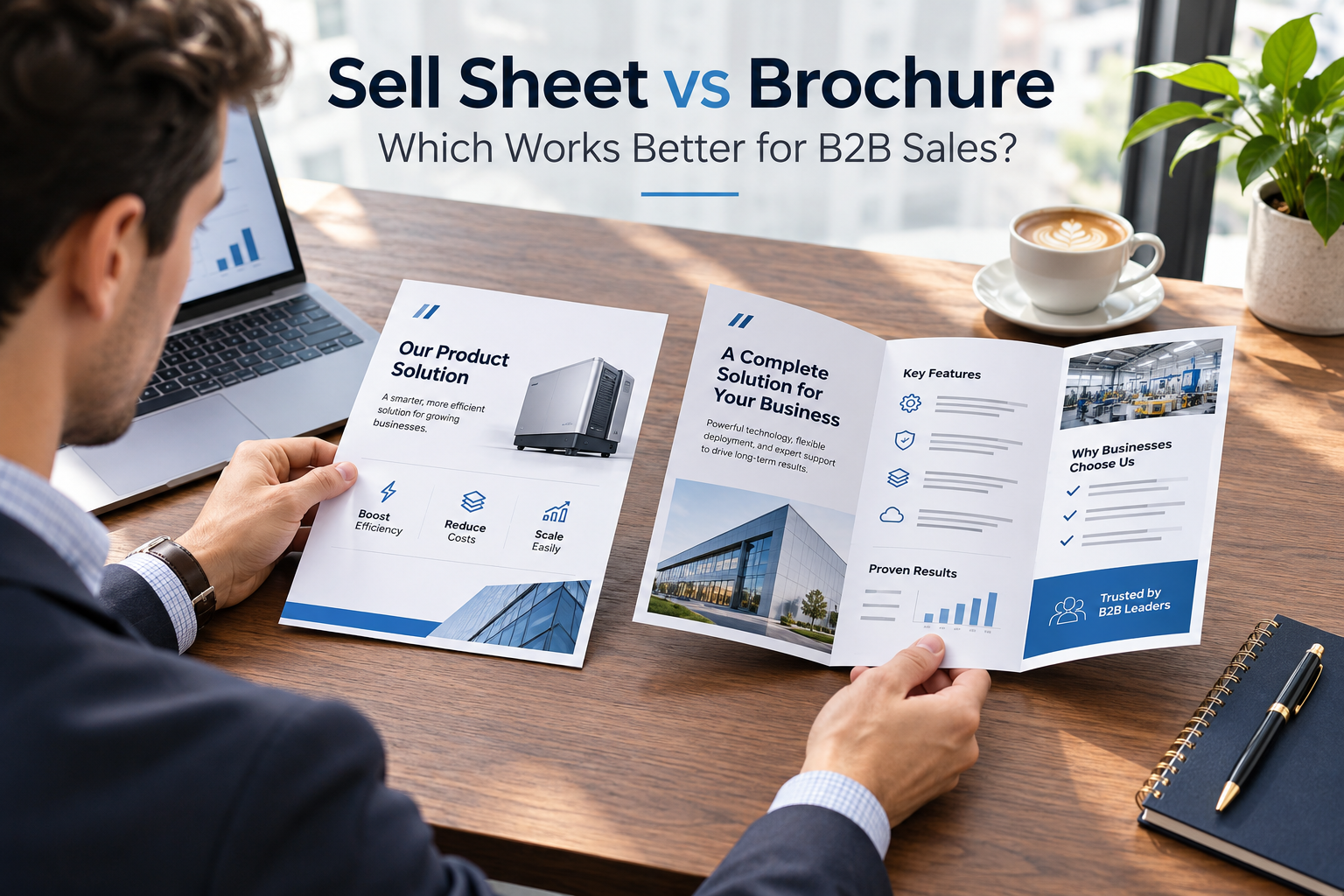
Picture this. You're at a business conference in Chicago, talking to a potential client who seems genuinely interested in your product. The conversation goes well. They ask for more information, and you reach into your bag. Do you hand them a sharp, single-page sell sheet or a beautifully designed brochure?
It's a small decision, but it can change how your product comes across. In B2B sales, buyers often have meetings to attend, budgets to review, and several people to convince before they can sign anything. That's why the Product Sell Sheet vs Brochure debate deserves more attention than it usually gets. Both formats can help, but they do different jobs.
If you're updating your company's sales materials, the design deserves just as much thought as the message. A Complete Brochure Design Solution can help you create a polished, consistent presentation, while a focused sell sheet gives buyers the essential product details. Knowing when to use each format makes the difference.
What Is a Product Sell Sheet, and How Is It Different From a Brochure?
A product sell sheet is usually a single-page document that introduces one product or service. Think of it as your elevator pitch, only dressed for a business meeting. It brings together the main benefits, useful specifications, product visuals, and a clear next step.
A brochure takes a broader approach. It may use folded panels or several pages to explain your company, services, product range, or unique selling points. Instead of focusing on one offer, it gives readers enough context to understand what your business can do for them.
Here's how I like to think about the difference: a sell sheet helps someone evaluate an offer, while a brochure helps them understand the bigger picture. One gets straight to the point. The other has room to tell a story. Neither needs to look like a boring corporate document from 2004.
Product Sell Sheet vs Brochure: Why the Buyer's Journey Matters
The right format depends on what your customer already knows. HubSpot's guide to sales collateral explains how different marketing materials support different stages of a buyer's journey. That makes sense. Someone discovering your company for the first time needs different information from a purchasing manager comparing your product with two competitors.
Product Sell Sheet vs Brochure: Key Differences
Before spending money on design or printing, it helps to understand where each format fits into your B2B marketing strategy.
|
Feature |
Product Sell Sheet |
Brochure |
|
Main purpose |
Sell a specific product or service |
Introduce a business or range of offerings |
|
Typical length |
One page |
Folded panels or multiple pages |
|
Content |
Benefits, specifications, proof, CTA |
Company story, services, benefits, visuals |
|
Best audience |
Buyers evaluating a particular solution |
Prospects exploring your business |
|
Common use |
Sales follow-ups, proposals, product meetings |
Trade shows, introductions, presentations |
|
Reading experience |
Quick and focused |
More detailed and exploratory |
|
Updates |
Usually easier to revise |
May require more layout changes |
The biggest difference isn't really the number of pages. It's the question each document answers.
A sell sheet answers, "Why should I consider this product?" A brochure answers, "What does this company offer, and why should I trust it?"
That's the heart of the Product Sell Sheet vs Brochure comparison.
When Does a Product Sell Sheet Work Better for B2B Sales?
Imagine you're selling industrial equipment to a manufacturing company in Texas. The operations manager wants to know about performance, compatibility, maintenance, and cost. They're probably not looking for your company history.
This is where a product sell sheet earns its place.
1. When Buyers Need Answers Quickly
A good sales one-pager removes unnecessary reading. Your prospects can find the main benefits, technical details, and contact information without searching through several pages.
For busy decision-makers, that convenience matters. You're making their research easier, which is exactly what useful sales collateral should do.
2. When You're Promoting One Specific Solution
Let's say your SaaS company launches a new reporting tool. A focused sell sheet can explain what it does, who needs it, how it fits existing workflows, and why it's worth a closer look.
Rather than showing every product in your portfolio, you're giving one solution the spotlight.
3. When Your Sales Team Needs Something Easy to Share
After a discovery call, a sales representative can send a one-page PDF that matches the buyer's interests. That document can also travel internally to department heads, finance teams, and purchasing managers.
To make it useful, include:
- A clear product headline and customer problem
- Three or four meaningful benefits
- Relevant specifications and supporting evidence
- A product image or simple diagram
- One clear call to action
Keep the layout spacious. A sell sheet should feel helpful, not like someone squeezed an entire website into a letter-sized page.
When Is a Brochure the Better B2B Marketing Tool?
Now imagine a healthcare organization reviewing vendors for a long-term service contract. It wants to understand each company's experience, service coverage, approach, and capabilities.
A single page might not provide enough information.
1. When You're Introducing Your Business
A professional brochure gives your company room to explain its background, strengths, and services. It helps prospects see your business as more than a single product.
This works especially well for consulting firms, construction companies, manufacturers, and professional service providers.
2. When You Offer Several Products or Services
If you sell five related solutions, creating separate product sheets for an initial introduction may overwhelm your prospect.
A well-organized brochure can present the entire range without making readers feel they're studying for an exam.
3. When Your Brand Story Builds Trust
Some purchases involve more than specifications. Buyers may want to understand your process, customer support, industry experience, and long-term commitment.
A brochure gives you space for customer examples, project photography, service explanations, and verified credentials. It also works well as a physical takeaway at exhibitions or business networking events.
Product Sell Sheet vs Brochure: Which Design Converts Better?
Good design isn't about adding more colors, dramatic shapes, or fashionable fonts. It's about making information easier to understand.
For a product sell sheet design, lead with the customer's problem and your solution. Use a strong headline, one main visual, and short sections. If you're selling technical equipment, make specifications easy to scan and distinguish verified facts from promotional claims.
For brochure design for businesses, build a clear reading flow. Start with an engaging introduction, organize services into logical sections, and support important messages with relevant images.
Both formats need readable type, consistent branding, enough white space, and a clear next step. A beautiful brochure with confusing information is still confusing. Just in nicer shoes.
Can You Use a Sell Sheet and Brochure Together?
Absolutely. In fact, using both can make your B2B sales materials more useful across a longer buying process.
Consider a commercial security company. At a trade show, its team shares a brochure introducing surveillance, access control, and monitoring services. A week later, an interested facilities manager requests details about one access control system.
The sales representative sends a dedicated sell sheet with key features, integration requirements, and a consultation invitation.
The brochure created context. The sell sheet supported a more specific conversation.
That's a practical answer to the Product Sell Sheet vs Brochure question: don't force one document to handle every stage of the relationship.
How to Choose the Right Sales Collateral for Your Business
Before designing anything, ask yourself three questions.
What does the buyer need to decide? If they're comparing one product against alternatives, choose a sell sheet. If they're evaluating your company's overall capabilities, a brochure may be more appropriate.
Where will they receive it? A short PDF works well after a sales call. A printed brochure may be more useful at an industry exhibition, where visitors want something tangible to take home.
How often will the information change? Products with frequently updated specifications or pricing may be easier to manage through a digital sell sheet. Brochures often suit more stable company information.
Also, consider who will read the document. An engineer may want technical details. A financial decision-maker may care more about implementation costs and expected business value.
Tailoring your message to those needs usually matters more than choosing the trendiest design.
How Do You Measure Which Format Drives More Sales?
Don't judge marketing materials by appearance alone. You need to know whether they help buyers move forward.
Track relevant actions such as document views, consultation requests, qualified replies, and meetings scheduled after sharing a piece of collateral.
For example, you could compare two follow-up email campaigns, one featuring a sell sheet and another using a brochure. Keep the audience and offer as similar as possible so your results are meaningful.
Remember, a download doesn't automatically mean purchase intent. Look at the quality of the conversations that follow, not just the number of clicks.
Conclusion: Which One Should You Choose?
The Product Sell Sheet vs Brochure decision comes down to your audience, message, and sales goals. A sell sheet works well when buyers need focused product information. A brochure makes more sense when they need a wider view of your company and its capabilities.
Neither format guarantees a sale. Clear messaging, useful information, thoughtful design, and timely follow-up make the real difference.
Ready to improve your B2B sales materials? Review what your customers need, identify gaps in your current documents, and invest in professional designs that communicate your message clearly. Whether you need a product sell sheet or a business brochure, the right design can make every sales conversation more effective. Contact us today to create professional sales materials that capture attention, build trust, and turn prospects into customers.
Frequently Asked Questions
1. What is the main difference between a product sell sheet and a brochure?
A product sell sheet focuses on one specific product or service, while a brochure usually introduces a company, its capabilities, or multiple offerings in greater detail.
2. Are product sell sheets effective for B2B sales?
Yes. They can help sales teams communicate product benefits, explain technical details, and answer buyer questions quickly. Their effectiveness depends on relevance, content quality, and timing.
3. Which is more affordable: a sell sheet or a brochure?
A basic one-page sell sheet often costs less to produce than a detailed multipage brochure. However, design complexity, revisions, photography, and printing affect the final price.
4. Can a product sell sheet replace a company brochure?
Sometimes. If you sell one straightforward solution, a sell sheet may be enough. Businesses with several services or complex offerings may still benefit from a broader brochure.
5. Should B2B companies use digital or printed sales materials?
Both can work. Digital PDFs are easy to distribute and update, while printed materials can be useful for trade shows and face-to-face meetings. Choose based on your buyers' preferences.

.png)
.png)
Comments
Update Comment